
Ghosts
Fishing the Shieldaig Lochs of Gairloch

It is raining but only gently. We follow the track into the hills from Shieldaig Farm. After a few minutes, a left turn takes us onto a narrow path and into birch woodland. It is late September. The birch leaves are mostly still green but the bracken is rust brown. There is a sign planted at the side of the path, fluorescent background and stark black lettering, pointing the way to the Fairy Lochs crash site. It looks a little incongruous, as if the accident had happened in the last few weeks rather than eighty years ago.
We emerge from the woodland and the gradient steepens and the path becomes rocky, twisting around waterlogged hollows in the sodden peat. We are following the burn, the Allt na Glaic-Sieldaig, upstream to its source. We pause for breath and look back. The skies to the northwest are clearer now. We can see across Loch Gairloch to Longa Island and North Erradale. Across the Minch, the Isle of Lewis is clearly visible. We do not stop for too long. The Fairy Loch is not far now.
A small frog lands on the path in front of me and hesitates. Meeting a frog always makes me smile. Their unapologetic absurdity reminds us not to take ourselves too seriously. I think of Norman MacCaig, the late poet, angler, and fellow admirer of frogs, and smile again. I wonder, as I often do when fishing in the hills, whether he made it here before me.
There is a gate in the deer fence to pass through and then we arrive where the burn flows out of the loch below Sithean Mòr. Sithean means a small rounded hill, often one thought to be a fairy hill. And so, improbably, we find ourselves under the big small fairy hill.
The map suggests that we are barely a mile from where we started and a modest couple of hundred metres above sea level. My lungs and legs are not persuaded.
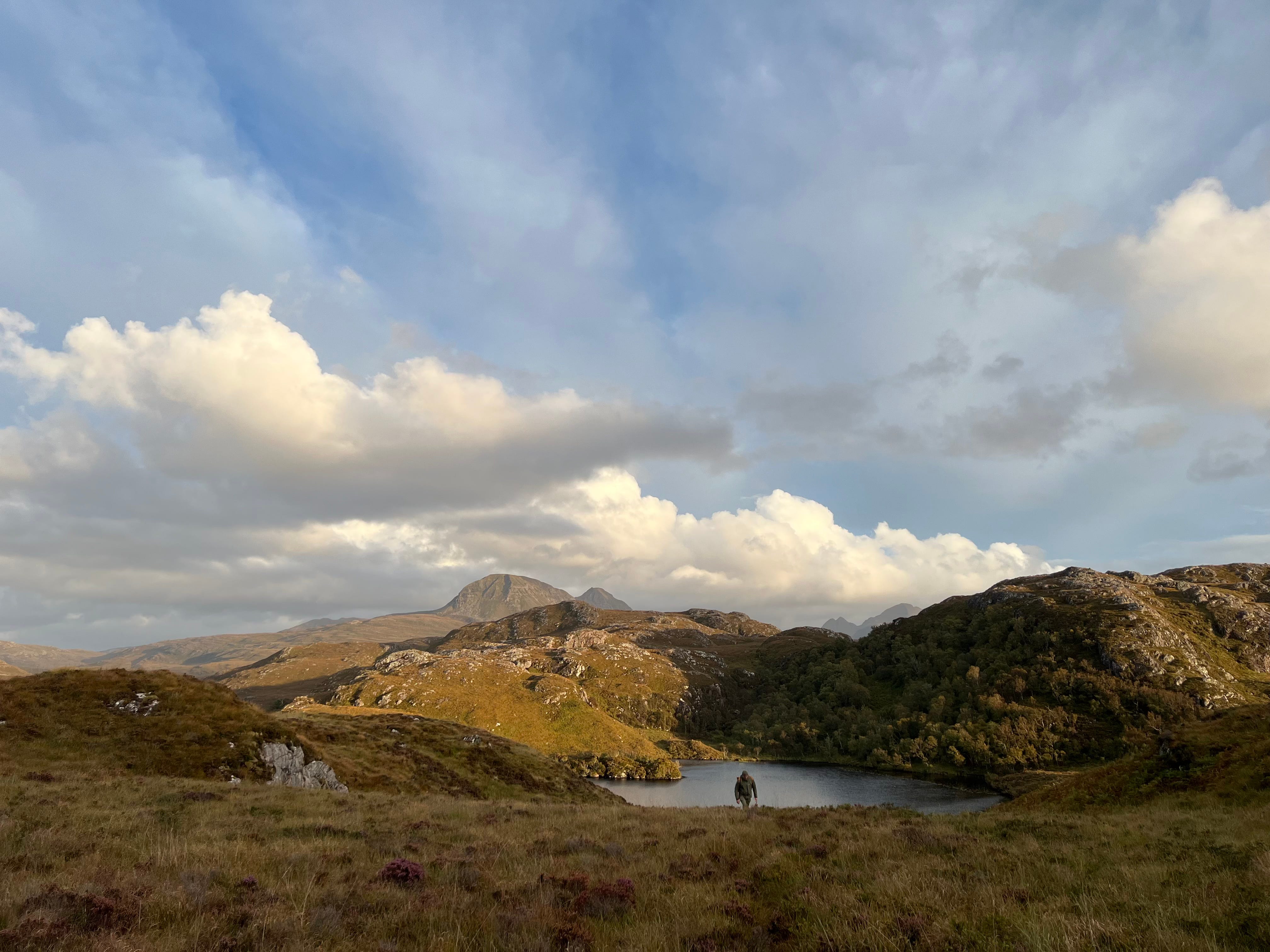
There is a moment of quiet. The view is startling. Towards the south, the clouds remain but sheets of sunlight penetrate. The surface of the Fairy Loch is momentarily too bright to allow the eyes to settle on it. All around us wet Lewisian Gneiss shines and sparkles as if now, two billion and seven hundred million years after its formation, its metamorphosis has started all over again.
In the distance the Torridon Hills are giants moving in and out of the cloud. Only Baosbheinn remains constant, conducting all that surrounds it and fulfilling its mistranslated name, The Wizard’s Hill.
Neither of us are strangers to the landscape of the north west of Scotland, so should not be as surprised as we are in this moment by its capacity for the extraordinary.
We are here to fish for wild brown trout. The season is nearing its end. Soon our rods will be packed away for the long Scottish winter. This is our last chance, or our last chance for this year at least. The day before we had taken a boat on Loch Clàir. The wind was up and the rowing was as close to impossible as we dared to attempt but we had both caught fish and stirred a few more.
We tie on our casts. I prefer three traditional wet flies, Kate McLaren, Soldier Palmer, and a Black Pennell on the point. We fish the north bank of the Fairy Loch allowing each other plenty of space and, as I fall into the rhythm of cast, pause, and then retrieve, it is as if I am completely alone in this vast empty landscape.
We move on to a small satellite lochan and cast towards it from as far back from the water’s edge as our ability allows in an effort to minimise the inevitable disturbance caused by the steps of two heavily booted men in waterproofs, as clumsy and absurd as the frogs. By the time we stop for lunch neither of us has seen a fish move let alone trouble our flies. A fish-less morning will always cause a rising sense of anxiety but there is time in the day yet and we have been warned that these trout are occasionally dour. We know what that means.
Sheltered in the lee of a large boulder we have a picnic of sandwiches and a little whisky for encouragement. Restored, we make the short tussocky descent to Lochan Sgeireach where we both have more luck. A brownie takes my Soldier Palmer. It has a pretty gold belly and is decorated with silver rimmed black spots. Before long another, slightly larger with similar colouring, takes the same fly. Both are released with gratitude.
We continue south to Diamond Loch, where I scramble down a rock face to get a clear cast towards some little islands. It looks like a promising spot but my efforts there are in vain. I lose flies, my footing, and, briefly, my temper.
Time is moving on and at last we reach the final two lochans of the day, Loch na Doire Bige and Loch na Doire More. After waiting to let a heavy rain shower pass, I give up my stubborn insistence on fishing with my cast of wet flies and tie on a single Loch Ordie. I add some grease to ensure that it will rest on the surface of the water.
On the way back, we pass above the USAAF B-24-H Liberator memorial. All fifteen crew and passengers perished when the off course bomber crashed into the ground and lochan that now we look out on in the fading light. They had just started their journey home to America from Prestwick. It was a month after the end of the War in Europe.
The debris is still strewn around the bog and lochans. A solitary propellor stands in the water, now known as Aeroplane Loch. The scar in the earth at the crash site looks disquietingly fresh. There is a makeshift memorial made of gathered wreckage. A plaque lists the names of the dead, mostly young men in their early twenties, and their home states: Kansas, Michigan, Wisconsin, Oregon, Iowa, Texas, Indiana, New York, North Carolina, New Jersey, and Massachusetts.
Days later, behind my desk in Edinburgh, perhaps still a little haunted by the memories of the War Grave, I remember that I have a copy of the family history that my grandfather wrote to pass on to his children and that, towards the end, there are some of his own reminisces of the War. I flick quickly through hundreds of years of births, marriages, and deaths but, before I get as far as the War years, my eye is caught by a long paragraph on his childhood in the 1920s and 1930s and I find that he had visited the area around Gairloch for long summer holidays. “We revelled in the beauty of Loch Maree and the sea lochs of the west and north, the mountains and rivers, the hill lochans and the Highland burns where we caught our breakfasts of ‘brownies’ on fly or worm.”
We reach a sheltered corner of Loch na Doire Bige. The wind that carried through the last shower has dropped and the sun offers a little early evening warmth. Birch and rowan trees stand around lily pads. The water is still. Here, higher up, more of the leaves have turned yellow. The last of the low light is golden and the clouds have now lifted from the Torridon Hills. I cast my lone fly into a gap at the edge of the lilies and wait.
I wonder, as I often do when fishing in the hills, whether he made it here before me.
Wow, the part about the frog made me pause. That idea of not taking ourselves too seriously, even amidst a weighty journey, is truely profound. What other small observations help ground you like that? You have such an insightful way of weaving together experience and reflection.